%20rotate(45)'%3e%3cpath%20fill='%23B78437'%20d='%20M%200%200%20H%20113%20V%2061%20H%20140%20V%200%20H%20255%20V%20113%20H%20193%20V%20142%20H%20255%20V%20255%20H%20142%20V%20190%20H%20115%20V%20255%20H%200%20V%20141%20H%2063%20V%20113%20H%200%20Z'/%3e%3c!--%20Top%20/%20north%20ribbon%20--%3e%3cpath%20fill='%23FFFCF4'%20d='%20M%2023%2023%20H%2092%20V%20143%20H%2074%20V%2042%20H%2041%20V%2072%20H%2064%20V%2091%20H%2023%20Z'/%3e%3c!--%20Right%20/%20east%20ribbon%20--%3e%3cpath%20fill='%23FFFCF4'%20d='%20M%20164%2023%20H%20232%20V%2092%20H%20112%20V%2073%20H%20212%20V%2043%20H%20181%20V%2062%20H%20164%20Z'/%3e%3c!--%20Bottom%20/%20south%20ribbon%20--%3e%3cpath%20fill='%23FFFCF4'%20d='%20M%20162%20105%20H%20180%20V%20213%20H%20213%20V%20181%20H%20189%20V%20162%20H%20232%20V%20232%20H%20162%20Z'/%3e%3c!--%20Left%20/%20west%20ribbon%20--%3e%3cpath%20fill='%23FFFCF4'%20d='%20M%2025%20158%20H%20144%20V%20177%20H%2044%20V%20210%20H%2076%20V%20188%20H%2095%20V%20229%20H%2025%20Z'/%3e%3c!--%20Ether%20/%20unifying%20centre%20--%3e%3cpath%20fill='%23FFFCF4'%20d='M%20112%20109%20H%20145%20V%20143%20H%20112%20Z'/%3e%3c/g%3e%3c/svg%3e)
Osteopathy · 8 min
Jaw pain and osteopathy: CMD, the jaw and the neck
Jaw pain, TMJ dysfunction (CMD), teeth grinding and neck tension: how the jaw, muscles, stress and neighbouring structures interact, and how they are examined osteopathically.
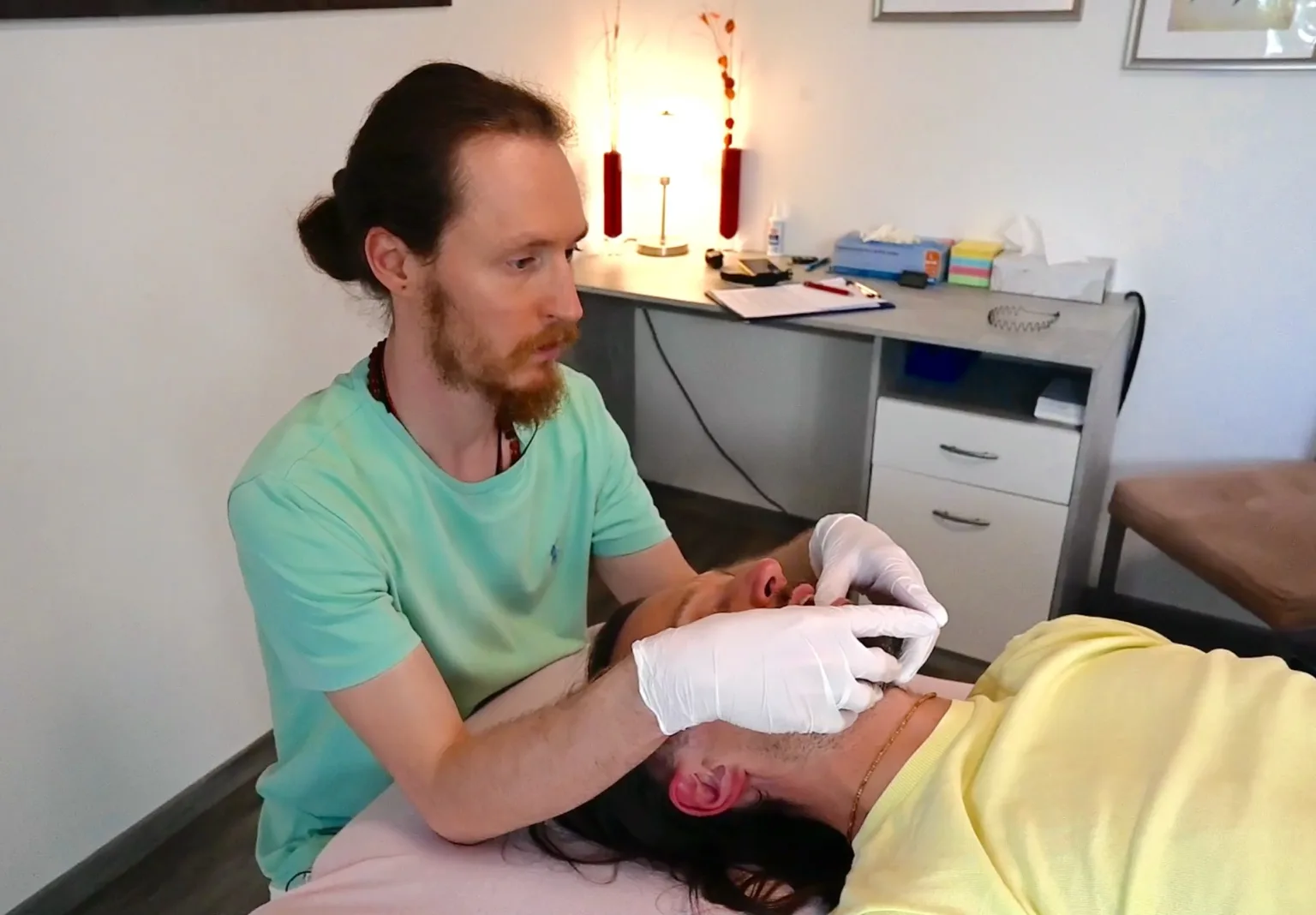
The jaw is not an isolated joint. The temporomandibular joints, chewing muscles, skull, cervical spine and shoulder girdle all work together during speaking, chewing, swallowing and many everyday movements. This is why, with jaw complaints, it can make sense not to examine only the area that hurts.
What symptoms can occur in the jaw area?
Typical symptoms include pain or tension in the chewing muscles, restricted or asymmetric mouth opening, discomfort when chewing, and clicking or grinding in the jaw joint. Nighttime teeth grinding or unconscious clenching can also place considerable strain on the jaw.
Some patients also report neck tension, headaches, or a feeling of tightness in the face at the same time. Whether these complaints are actually connected cannot be determined simply from their location — that's exactly what the examination is for.
What does CMD mean?
CMD stands for craniomandibular dysfunction. The term describes functional disorders in how the jaw joints, chewing muscles and neighbouring structures work together.
CMD is not a single, clearly defined condition with just one cause. Depending on the situation, tooth position, jaw function, muscles, habitual strain, bruxism and other factors can all play a role. This is why working together with dentists or orthodontists can be worthwhile.
How do I examine jaw complaints?
At the start, I want to know when the complaints occur, how the jaw behaves when opening and closing, and whether grinding, clenching, a splint, or previous dental or orthodontic treatment play a role.
Depending on the question at hand, I then examine jaw mobility and chewing muscles, as well as the cervical spine, shoulder girdle and neighbouring tissue. Not every area of tension outside the jaw is automatically relevant — what matters is what shows up clearly in the individual findings.
What can osteopathic treatment look like?
Depending on the findings, I may work directly on the chewing muscles and jaw joint, or include neighbouring areas such as the neck, upper thoracic spine and shoulder girdle.
This mostly involves targeted manual techniques, mobilisations and gentle tissue techniques. There's no fixed 'jaw programme' — treatment is guided by which structures are actually showing findings.
Bruxism and teeth clenching
Grinding and clenching can place considerable strain on the chewing muscles and jaw joints over time. Osteopathic and manual treatment can primarily address areas of increased tension or restricted mobility.
At the same time, it's worth asking why the jaw is under such strain in the first place. A splint, dental factors, sleep, habits and overall stress levels can all be just as relevant.
Stress, emotions and psychosomatic connections
The jaw is an area where, for some people, inner tension shows up very directly. During stressful periods, teeth are clenched more often, the chewing muscles remain unconsciously tense, or nighttime bruxism increases.
That's why, where the findings fit, I also discuss whether stress, inner tension or particular emotional strain is currently present. Sometimes breathing, muscle tone, or the feeling in the jaw already changes during such a conversation.
For me, psychosomatics doesn't mean explaining physical complaints as 'just psychological'. Physical, dental and emotional factors can be present at the same time and influence one another.
Osteopathy and dentistry complement each other
With jaw complaints, I don't see osteopathy as an alternative to dentistry. Where teeth, bite, jaw joint or a splint need dental assessment, that clarification belongs in the appropriate professional hands.
Osteopathic treatment additionally looks at mobility, muscle tension, and functional connections with neighbouring regions of the body.
My approach
With jaw complaints, I don't try to find a single cause for everything. What matters is the overall picture: How does the jaw move? Where is there tension? What role do the neck and shoulder girdle play? Is there clenching or grinding? And are there factors that keep triggering this tension?
From this information comes an individual treatment — physically precise, and open to the various levels that can come together in jaw complaints.
Important information
In the case of acute toothache, swelling, signs of inflammation, injury, or unclear and pronounced jaw complaints, dental or medical clarification is required.