%20rotate(45)'%3e%3cpath%20fill='%23B78437'%20d='%20M%200%200%20H%20113%20V%2061%20H%20140%20V%200%20H%20255%20V%20113%20H%20193%20V%20142%20H%20255%20V%20255%20H%20142%20V%20190%20H%20115%20V%20255%20H%200%20V%20141%20H%2063%20V%20113%20H%200%20Z'/%3e%3c!--%20Top%20/%20north%20ribbon%20--%3e%3cpath%20fill='%23FFFCF4'%20d='%20M%2023%2023%20H%2092%20V%20143%20H%2074%20V%2042%20H%2041%20V%2072%20H%2064%20V%2091%20H%2023%20Z'/%3e%3c!--%20Right%20/%20east%20ribbon%20--%3e%3cpath%20fill='%23FFFCF4'%20d='%20M%20164%2023%20H%20232%20V%2092%20H%20112%20V%2073%20H%20212%20V%2043%20H%20181%20V%2062%20H%20164%20Z'/%3e%3c!--%20Bottom%20/%20south%20ribbon%20--%3e%3cpath%20fill='%23FFFCF4'%20d='%20M%20162%20105%20H%20180%20V%20213%20H%20213%20V%20181%20H%20189%20V%20162%20H%20232%20V%20232%20H%20162%20Z'/%3e%3c!--%20Left%20/%20west%20ribbon%20--%3e%3cpath%20fill='%23FFFCF4'%20d='%20M%2025%20158%20H%20144%20V%20177%20H%2044%20V%20210%20H%2076%20V%20188%20H%2095%20V%20229%20H%2025%20Z'/%3e%3c!--%20Ether%20/%20unifying%20centre%20--%3e%3cpath%20fill='%23FFFCF4'%20d='M%20112%20109%20H%20145%20V%20143%20H%20112%20Z'/%3e%3c/g%3e%3c/svg%3e)
Osteopathy · 7 min
Osteopathy: gentle techniques or manipulation?
Gentle osteopathic techniques, mobilisation or targeted manipulation: how do these methods differ, and what role does the well-known 'cracking' sound actually play?
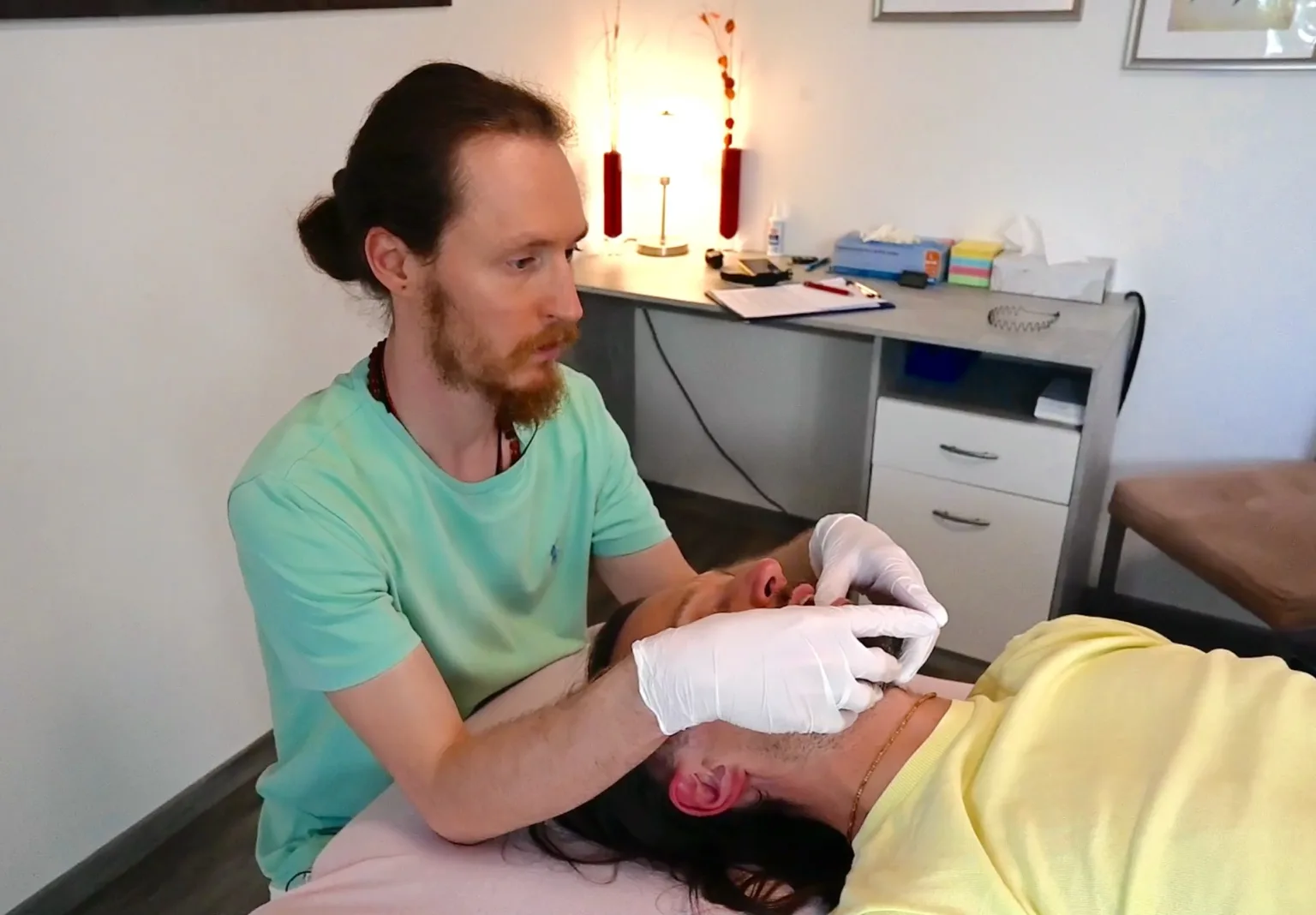
Osteopathic treatment can look very different from one session to the next. Sometimes I work with calm, gentle tissue techniques, sometimes with mobilisations and — when the findings call for it — a short, targeted manipulation of a joint. Which technique is appropriate isn't decided by what feels most intense, but by the examination, the goal, and the individual situation.
The examination comes first
Before choosing a technique, I want to understand how the complaint presents itself and which structures are actually relevant. This involves taking a case history, testing movement, and manually examining the joints and tissue.
Only then does the treatment follow. For me, a technique is not a fixed ritual but a tool that should suit a specific set of findings.
Gentle osteopathic techniques
Many osteopathic techniques use comparatively little force. Through the hands, it's possible to sense — and specifically influence — tension, mobility and the tissue's response.
Especially with sensitive areas, or with patients for whom a stronger technique wouldn't be appropriate, work can proceed very calmly. Gentle doesn't automatically mean superficial — and forceful doesn't automatically mean more effective.
Mobilisation — movement without a rapid impulse
With mobilisation, a joint is moved in a controlled way within its normal range of motion. This movement can be repeated, rhythmic, or very precisely targeted.
Mobilisations can be dosed well and can be used either on their own or alongside other osteopathic techniques.
Targeted manipulation and the well-known 'crack'
In certain cases, a manipulative technique can be appropriate. This is often a short, precise impulse with a small range of movement — frequently referred to as an HVLA technique (High Velocity, Low Amplitude).
An audible sound can occur during this. However, this 'crack' is not the aim of the treatment, nor is it proof that a technique has worked. For me, a good manipulation is characterised above all by precision, appropriate dosage, and a suitable indication.
Does a manipulation have to be forceful?
No. With manipulative techniques in particular, the aim is not to use as much force as possible. What matters is the starting position, direction, speed, and a small, controlled movement.
My principle is: as much as necessary — but no more than that.
Why doesn't every patient receive the same technique?
People differ in mobility, tissue tension, age, history and personal sensitivity. Even two patients with pain in the same spot can have completely different findings.
That's why I don't use a standard programme in which certain vertebrae or joints are routinely manipulated at every appointment.
Safety is part of the technique
Before a targeted manipulation, I check whether the technique is suitable for the situation. Case history, examination, possible pre-existing conditions and current symptoms determine whether manipulation makes sense or whether a different approach is better suited.
If anything is unclear, or if further diagnostics appear necessary, clarification takes priority.
My approach
I don't work on a 'gentle or forceful' principle — I choose the technique based on what the examination reveals. A treatment might consist almost entirely of calm manual techniques, or it might include a targeted manipulation at a particular point.
The aim is neither the cracking sound nor the strongest possible treatment. What matters is a precise, comprehensible and individually tailored treatment.
Important information
Osteopathic methods are, in part, classed as complementary medicine. The scientific evidence varies depending on the condition and the method used. Osteopathic treatment does not replace necessary medical diagnosis or treatment.