%20rotate(45)'%3e%3cpath%20fill='%23B78437'%20d='%20M%200%200%20H%20113%20V%2061%20H%20140%20V%200%20H%20255%20V%20113%20H%20193%20V%20142%20H%20255%20V%20255%20H%20142%20V%20190%20H%20115%20V%20255%20H%200%20V%20141%20H%2063%20V%20113%20H%200%20Z'/%3e%3c!--%20Top%20/%20north%20ribbon%20--%3e%3cpath%20fill='%23FFFCF4'%20d='%20M%2023%2023%20H%2092%20V%20143%20H%2074%20V%2042%20H%2041%20V%2072%20H%2064%20V%2091%20H%2023%20Z'/%3e%3c!--%20Right%20/%20east%20ribbon%20--%3e%3cpath%20fill='%23FFFCF4'%20d='%20M%20164%2023%20H%20232%20V%2092%20H%20112%20V%2073%20H%20212%20V%2043%20H%20181%20V%2062%20H%20164%20Z'/%3e%3c!--%20Bottom%20/%20south%20ribbon%20--%3e%3cpath%20fill='%23FFFCF4'%20d='%20M%20162%20105%20H%20180%20V%20213%20H%20213%20V%20181%20H%20189%20V%20162%20H%20232%20V%20232%20H%20162%20Z'/%3e%3c!--%20Left%20/%20west%20ribbon%20--%3e%3cpath%20fill='%23FFFCF4'%20d='%20M%2025%20158%20H%20144%20V%20177%20H%2044%20V%20210%20H%2076%20V%20188%20H%2095%20V%20229%20H%2025%20Z'/%3e%3c!--%20Ether%20/%20unifying%20centre%20--%3e%3cpath%20fill='%23FFFCF4'%20d='M%20112%20109%20H%20145%20V%20143%20H%20112%20Z'/%3e%3c/g%3e%3c/svg%3e)
Osteopathy · 6 min
Osteopathy — understanding the body as a whole
How does osteopathy work? Discover why case history, examination and the interplay between different regions of the body form the basis of an individually tailored osteopathic treatment.
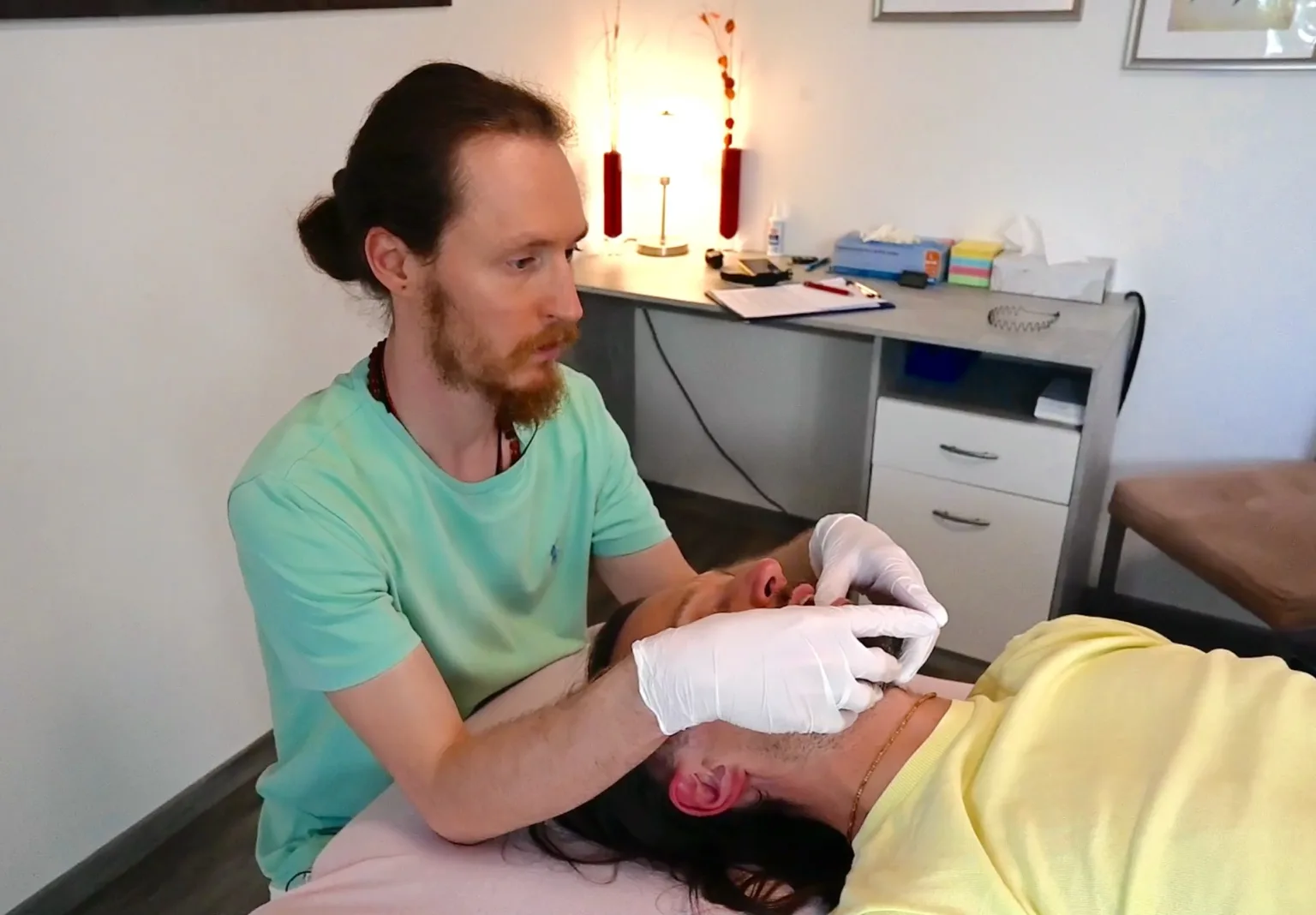
Symptoms don't always occur exactly where they are felt. That's why osteopathy looks not only at the painful area, but also at how it functionally interacts with other parts of the body.
What does a holistic view mean?
The human body is made up of many structures that are mechanically and functionally connected. Joints, muscles, fasciae and other tissues influence one another. For this reason, it can make sense to include regions in an examination that at first don't seem directly connected to the main symptom.
For me, holistic doesn't mean trying to explain every complaint with a single theory. It means considering the individual person together with their history, the strains they've experienced, and the physical findings.
It starts with a conversation and an examination
Every treatment begins with a case history. This covers, among other things, the current complaints, how they have developed, previous injuries or operations, pre-existing conditions and any findings already available.
I then examine mobility, tissue tension and how different regions of the body work together. Only on this basis can I decide which treatment might be appropriate.
How is osteopathic treatment carried out?
Depending on the findings, different manual techniques may be used. These include gentle tissue techniques, mobilisations and — where appropriate and safe — targeted manipulative techniques.
For me, the intensity of a technique is not a measure of quality. Stronger doesn't automatically mean more effective. What matters is that the chosen technique suits the situation at hand.
Individual rather than by routine
Two people with similar complaints don't necessarily need the same treatment. Age, mobility, history, strain and examination findings can differ considerably.
That's why I don't work from a rigid standard programme. Treatment is derived from the individual findings and adjusted as it progresses.
When is further medical investigation advisable?
Not every complaint belongs in osteopathic treatment. Where there are indications of illness, injury or other situations requiring medical diagnostics, medical clarification takes priority first.
Important information
Osteopathic methods are, in part, classed as complementary medicine. The scientific evidence varies depending on the condition and the method used. Osteopathic treatment does not replace necessary medical diagnosis or treatment.