%20rotate(45)'%3e%3cpath%20fill='%23B78437'%20d='%20M%200%200%20H%20113%20V%2061%20H%20140%20V%200%20H%20255%20V%20113%20H%20193%20V%20142%20H%20255%20V%20255%20H%20142%20V%20190%20H%20115%20V%20255%20H%200%20V%20141%20H%2063%20V%20113%20H%200%20Z'/%3e%3c!--%20Top%20/%20north%20ribbon%20--%3e%3cpath%20fill='%23FFFCF4'%20d='%20M%2023%2023%20H%2092%20V%20143%20H%2074%20V%2042%20H%2041%20V%2072%20H%2064%20V%2091%20H%2023%20Z'/%3e%3c!--%20Right%20/%20east%20ribbon%20--%3e%3cpath%20fill='%23FFFCF4'%20d='%20M%20164%2023%20H%20232%20V%2092%20H%20112%20V%2073%20H%20212%20V%2043%20H%20181%20V%2062%20H%20164%20Z'/%3e%3c!--%20Bottom%20/%20south%20ribbon%20--%3e%3cpath%20fill='%23FFFCF4'%20d='%20M%20162%20105%20H%20180%20V%20213%20H%20213%20V%20181%20H%20189%20V%20162%20H%20232%20V%20232%20H%20162%20Z'/%3e%3c!--%20Left%20/%20west%20ribbon%20--%3e%3cpath%20fill='%23FFFCF4'%20d='%20M%2025%20158%20H%20144%20V%20177%20H%2044%20V%20210%20H%2076%20V%20188%20H%2095%20V%20229%20H%2025%20Z'/%3e%3c!--%20Ether%20/%20unifying%20centre%20--%3e%3cpath%20fill='%23FFFCF4'%20d='M%20112%20109%20H%20145%20V%20143%20H%20112%20Z'/%3e%3c/g%3e%3c/svg%3e)
Osteopathy · 7 min
Osteopathy for back and neck pain
Back or neck pain? Find out how I examine such complaints, which osteopathic and manual techniques may be considered, and when medical clarification is important.
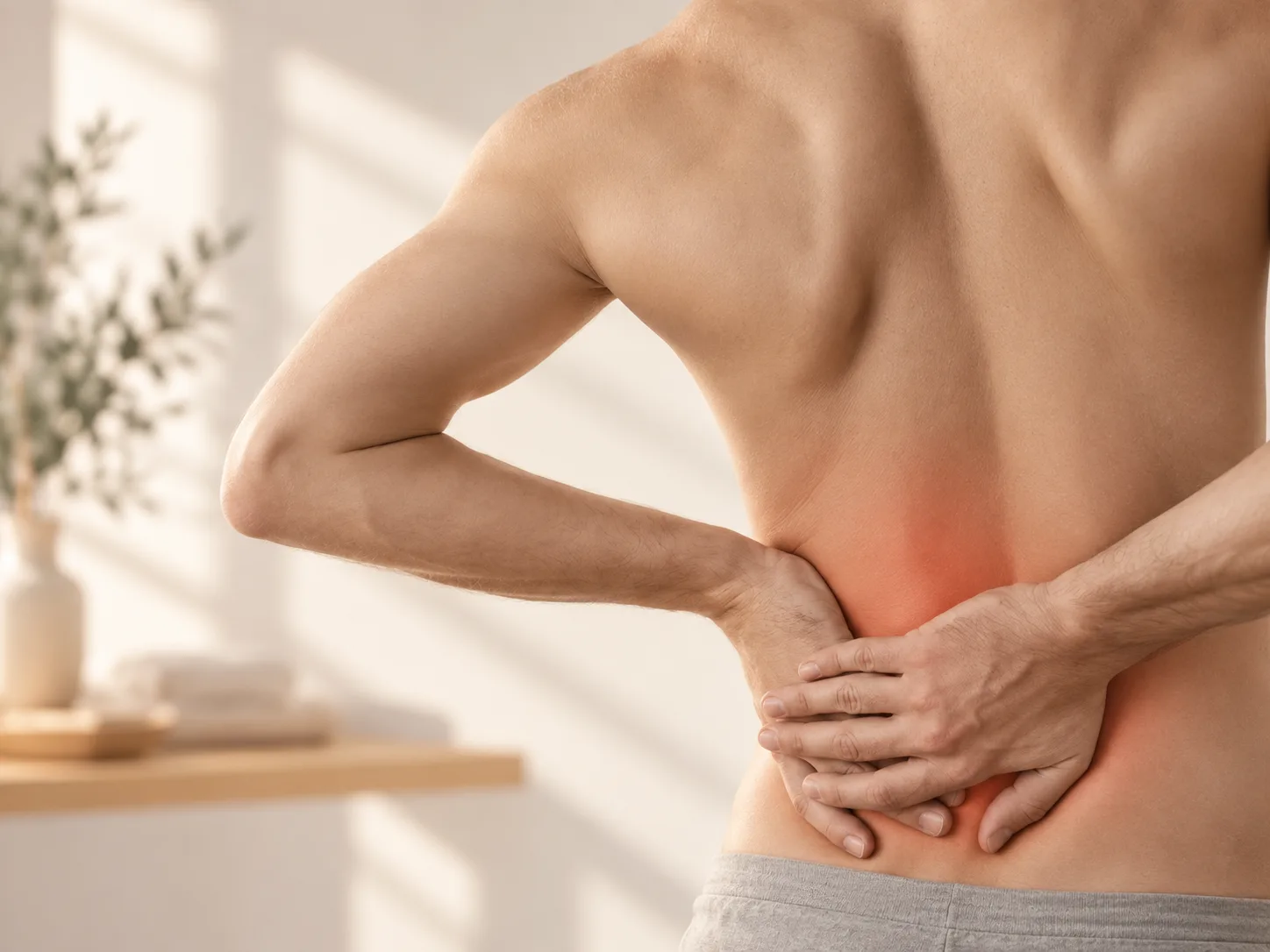
Back and neck pain are among the most common reasons people seek an osteopathic appointment. Even so, the same location of pain doesn't automatically mean the same cause. Movement habits, muscles, joints, strain, sleep, stress and previous injuries can all shape the clinical picture in different ways.
Pain is not the same as a diagnosis
A painful area can be very tense or sensitive to movement without there necessarily being any structural damage there. Conversely, changes may be visible on an MRI or X-ray without fully explaining the current complaints.
That's why I don't rely solely on images or on the exact spot where it hurts. What matters is the interplay between history, examination, and the current clinical picture.
What does 'blockage' actually mean?
In everyday language, people often say a vertebra is 'blocked' or 'out of place'. This can describe well the sensation of suddenly restricted or painful movement. Anatomically, however, it usually doesn't mean that a vertebra has actually shifted out of position.
For treatment, it's more relevant which movement is restricted or painful, how the muscles respond, and whether this pattern can be changed through targeted examination.
How do I examine the back and neck?
I first check which movements trigger or restrict the complaints. Joints, muscles and neighbouring regions can then be examined more specifically.
With neck complaints, for example, the transition to the thoracic spine or the shoulder girdle may be relevant. With lower back complaints, the pelvis and hips may also be considered. This doesn't follow a fixed, whole-body routine, but is guided by the individual findings.
What can treatment look like?
Depending on the situation, I work with muscle and tissue techniques, mobilisations, or targeted joint techniques. In suitable cases, a brief manipulative technique may also be used.
Neither the cracking sound nor the strength of the technique determines the quality of treatment. What matters is whether the chosen technique suits the findings and is appropriately dosed.
Acute and long-standing complaints
With acute complaints, the initial focus is often on making painful movement easier again and reducing unnecessary protective tension.
With long-standing complaints, it's also worth looking at recurring patterns of strain: Which movements are missing? What keeps triggering the complaints? What role do work, sport, everyday life, or ongoing tension play?
Movement is part of the overall picture
Manual treatment can provide a helpful impulse, but it doesn't automatically replace movement. Particularly with recurring back and neck complaints, it can be worthwhile to rebuild trust in movement after treatment and gradually place appropriate demands on the body again.
Not every patient needs a complicated exercise programme. Often, a few well-chosen changes are more helpful than a long list of exercises.
My approach
I don't go looking for the one 'wrong' vertebral position. I'm interested in which movement is currently restricted, which structures are involved, and what can be shown to change through treatment.
This keeps treatment focused: not correcting as much as possible, but addressing what actually appears relevant to the individual clinical picture.
Important information
Following a significant accident, or in the case of newly occurring marked muscle weakness or paralysis, disturbances of bladder or bowel function, numbness in the genital or saddle area, fever together with severe back pain, or other pronounced neurological or acute symptoms, prompt medical clarification is important.