%20rotate(45)'%3e%3cpath%20fill='%23B78437'%20d='%20M%200%200%20H%20113%20V%2061%20H%20140%20V%200%20H%20255%20V%20113%20H%20193%20V%20142%20H%20255%20V%20255%20H%20142%20V%20190%20H%20115%20V%20255%20H%200%20V%20141%20H%2063%20V%20113%20H%200%20Z'/%3e%3c!--%20Top%20/%20north%20ribbon%20--%3e%3cpath%20fill='%23FFFCF4'%20d='%20M%2023%2023%20H%2092%20V%20143%20H%2074%20V%2042%20H%2041%20V%2072%20H%2064%20V%2091%20H%2023%20Z'/%3e%3c!--%20Right%20/%20east%20ribbon%20--%3e%3cpath%20fill='%23FFFCF4'%20d='%20M%20164%2023%20H%20232%20V%2092%20H%20112%20V%2073%20H%20212%20V%2043%20H%20181%20V%2062%20H%20164%20Z'/%3e%3c!--%20Bottom%20/%20south%20ribbon%20--%3e%3cpath%20fill='%23FFFCF4'%20d='%20M%20162%20105%20H%20180%20V%20213%20H%20213%20V%20181%20H%20189%20V%20162%20H%20232%20V%20232%20H%20162%20Z'/%3e%3c!--%20Left%20/%20west%20ribbon%20--%3e%3cpath%20fill='%23FFFCF4'%20d='%20M%2025%20158%20H%20144%20V%20177%20H%2044%20V%20210%20H%2076%20V%20188%20H%2095%20V%20229%20H%2025%20Z'/%3e%3c!--%20Ether%20/%20unifying%20centre%20--%3e%3cpath%20fill='%23FFFCF4'%20d='M%20112%20109%20H%20145%20V%20143%20H%20112%20Z'/%3e%3c/g%3e%3c/svg%3e)
Osteopathy · 7 min
What happens during an osteopathic treatment?
What happens at a first appointment with an osteopath? From case history and examination through to individual treatment — this is how an osteopathic treatment proceeds in my practice in Erfurt.
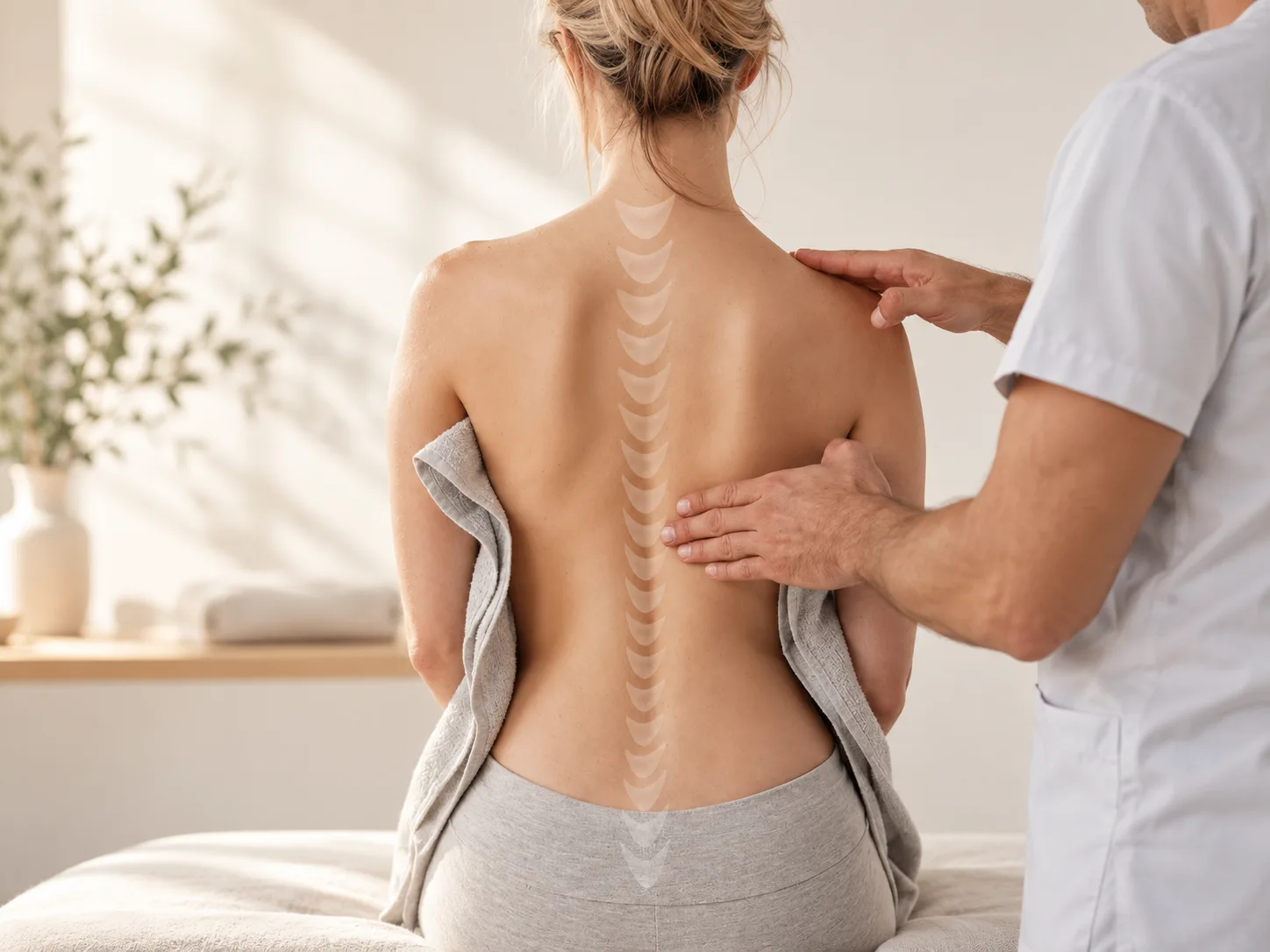
Many patients want to know what to expect before their first appointment. For me, osteopathic treatment isn't simply a set sequence of techniques. It begins with a conversation and an examination — only after that is it decided where and how treatment will take place.
1. Conversation and case history
At the start, you describe your current complaints: How long have they been present? What changes them? Have there been previous injuries, operations or illnesses? Any existing findings, imaging, or medical diagnoses can also be important for understanding the picture.
The conversation not only helps me understand possible connections. It also shows which areas should be examined more closely, and whether anything needs medical clarification before treatment begins.
2. Physical examination
I then examine the affected area and — where relevant to the question at hand — neighbouring regions of the body. Among other things, I assess movement, tissue tension, and how the body responds to certain movements or positions.
The examination should make clear which findings actually correspond to the complaints. Not every area of tension found needs to be treated.
Why do I sometimes examine somewhere other than where it hurts?
The body doesn't work as a collection of isolated parts. Movement in one area changes the strain and movement in other regions. With lower back pain, for example, the mobility of the hip, pelvis or ribcage can also be of interest; with jaw complaints, the neck may also be examined.
This doesn't mean that any distant structure is automatically the 'cause'. What matters is whether a functional connection can be meaningfully identified during the examination.
3. The treatment
Depending on the findings, treatment may consist of gentle tissue techniques, muscle techniques, mobilisations, or targeted joint techniques. A brief manipulation can also be part of the treatment in certain situations.
Which technique I use depends on the findings, the region of the body, the patient's history, and the individual situation — not on a fixed routine.
No treatment by formula
Two people can come in with the same complaint and still be treated differently. Age, mobility, strain, history and how the body responds can all differ.
That's why I don't automatically treat the same points in every patient, and I don't try to correct as many supposed 'blockages' as possible in a single session.
What happens after treatment?
After treatment, I often check the movement or pattern that stood out before, once more. This allows a direct comparison of what has changed.
Depending on the situation, simple recommendations regarding movement, strain, or everyday life may also be useful. Not every patient needs exercises or an extensive plan.
What should I bring to my first appointment?
If you have relevant medical reports, MRI/CT findings, X-rays, or lab results, feel free to bring them along. For the physical examination, clothing that allows movement to be properly assessed is helpful.
Above all, though, you don't need to prepare for any particular treatment. The first appointment is primarily about understanding your situation.
My approach
For me, good osteopathic treatment doesn't begin with a technique, but with a question: what is actually relevant for this person, in this situation?
Case history, examination and treatment therefore belong together. This creates an appointment that stays individual while still following a clear clinical logic.
Important information
In the case of acute or unclear complaints, medical diagnostics may be required before or alongside osteopathic treatment.