%20rotate(45)'%3e%3cpath%20fill='%23B78437'%20d='%20M%200%200%20H%20113%20V%2061%20H%20140%20V%200%20H%20255%20V%20113%20H%20193%20V%20142%20H%20255%20V%20255%20H%20142%20V%20190%20H%20115%20V%20255%20H%200%20V%20141%20H%2063%20V%20113%20H%200%20Z'/%3e%3c!--%20Top%20/%20north%20ribbon%20--%3e%3cpath%20fill='%23FFFCF4'%20d='%20M%2023%2023%20H%2092%20V%20143%20H%2074%20V%2042%20H%2041%20V%2072%20H%2064%20V%2091%20H%2023%20Z'/%3e%3c!--%20Right%20/%20east%20ribbon%20--%3e%3cpath%20fill='%23FFFCF4'%20d='%20M%20164%2023%20H%20232%20V%2092%20H%20112%20V%2073%20H%20212%20V%2043%20H%20181%20V%2062%20H%20164%20Z'/%3e%3c!--%20Bottom%20/%20south%20ribbon%20--%3e%3cpath%20fill='%23FFFCF4'%20d='%20M%20162%20105%20H%20180%20V%20213%20H%20213%20V%20181%20H%20189%20V%20162%20H%20232%20V%20232%20H%20162%20Z'/%3e%3c!--%20Left%20/%20west%20ribbon%20--%3e%3cpath%20fill='%23FFFCF4'%20d='%20M%2025%20158%20H%20144%20V%20177%20H%2044%20V%20210%20H%2076%20V%20188%20H%2095%20V%20229%20H%2025%20Z'/%3e%3c!--%20Ether%20/%20unifying%20centre%20--%3e%3cpath%20fill='%23FFFCF4'%20d='M%20112%20109%20H%20145%20V%20143%20H%20112%20Z'/%3e%3c/g%3e%3c/svg%3e)
Pregnancy · 7 min
Osteopathy during pregnancy
Osteopathy during pregnancy in Erfurt: how an individually tailored treatment for functional complaints of the back, pelvis and musculoskeletal system can work.
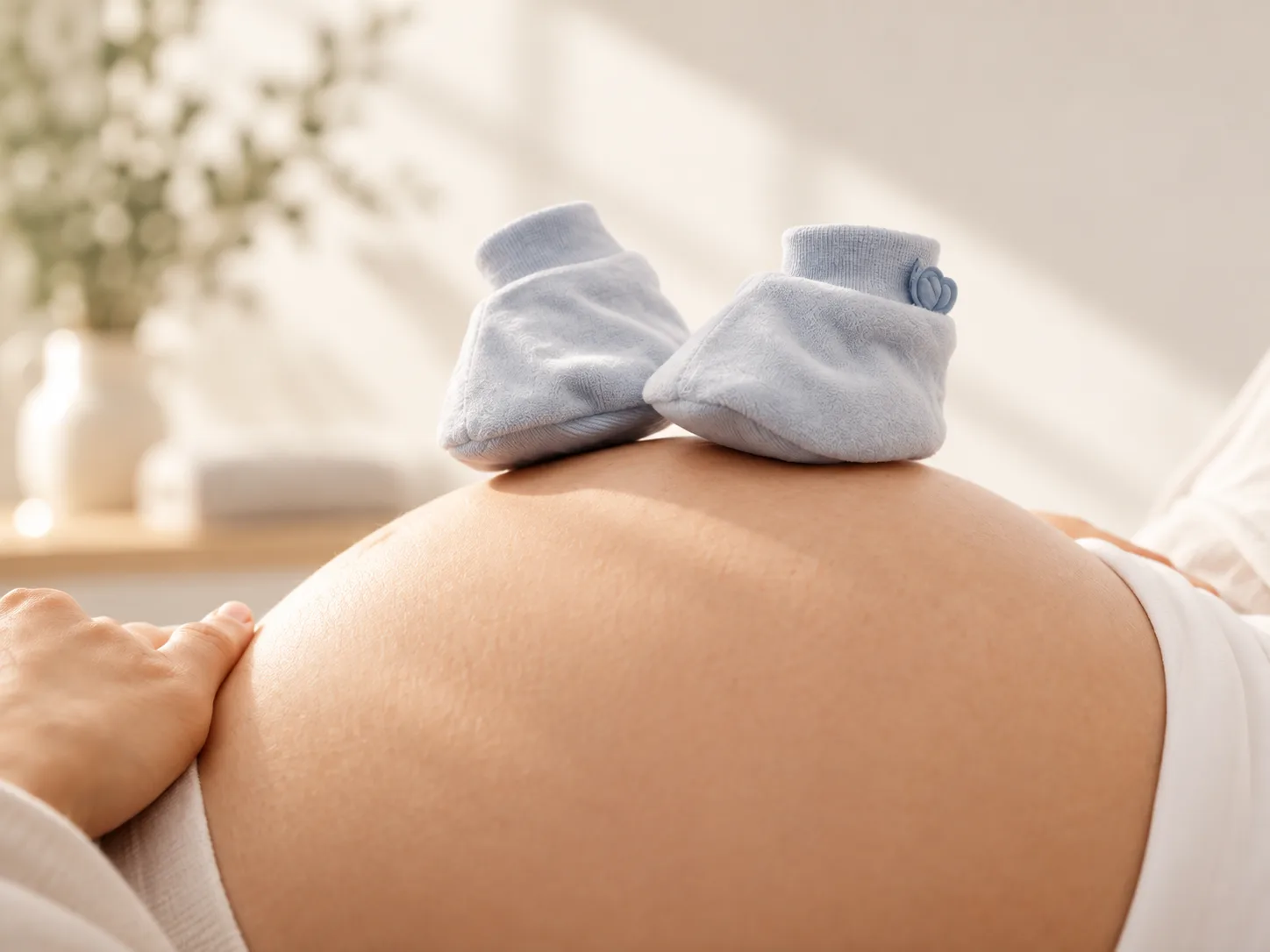
During pregnancy, the body is constantly changing. Weight and centre of gravity shift, the abdomen grows, and the pelvis, spine, muscles and breathing all adapt to the new situation. Some of these changes go unnoticed, while others are felt as tension, restricted movement, or pain.
In osteopathic treatment, my aim is to understand these changes individually and adapt the treatment to the stage of pregnancy, the complaints, and how the patient is currently feeling.
What complaints bring pregnant patients to the practice?
Often it involves complaints in the lower back, pelvis, or the sacroiliac joints. Neck and shoulder tension, discomfort in the ribs or chest, and a general feeling of restricted mobility can also occur.
Not every complaint is automatically a result of pregnancy. That's why, here too, the focus is first on what the examination actually reveals.
How do I examine during pregnancy?
At the start, we talk about the course of the pregnancy so far, the current complaints, and relevant medical information. I then examine posture, movement, and the affected areas of the body.
Positioning and examination are chosen to suit the particular stage of pregnancy and to feel comfortable for the patient.
What can treatment look like?
Depending on the findings, I work with gentle tissue techniques, muscle techniques, and careful mobilisations. The pelvis, spine, ribs, diaphragm and neighbouring structures can be included in treatment, depending on the complaint.
Intensity isn't based on a fixed formula. Especially during pregnancy, a well-dosed and precise treatment matters more than the use of force.
The pelvis and sacroiliac joints
Complaints around the sacrum, pelvis and sacroiliac joints are often described as a 'blockage' or a 'pelvic misalignment'. Such terms are easy to understand in everyday language, but they only give a simplified picture of the actual biomechanics involved.
For treatment, what matters more to me is how the pelvis and neighbouring structures move, where strain is occurring, and which movements change the complaints.
Are manipulations possible during pregnancy?
Not every treatment during pregnancy has to consist solely of very gentle touch. Which manual techniques are appropriate depends on the region of the body, the findings, how the pregnancy is progressing, and any possible risk factors.
A manipulation is never an end in itself. If a calmer technique achieves the same goal just as effectively, there's no reason to use a rapid impulse.
Physical tension, stress and psychosomatic aspects
Pregnancy brings more than just physical changes. New sensations, uncertainty about certain movements, worries about how the pregnancy is progressing, or thoughts about the birth can also influence how a person perceives and holds tension in their own body.
In my work, I take such psychosomatic connections into account where needed. Sometimes it becomes very clear during the conversation that a particular worry lies behind significant physical tension. When we discuss this calmly, make the connections understandable, and reduce unnecessary anxiety, breathing or bodily tension can sometimes already change during the appointment itself.
The conversation doesn't replace the physical examination. It complements it where physical and emotional tension are clearly linked.
My approach
I take into account the stage of pregnancy, the complaints, how things have progressed so far, the physical findings, and how the patient is currently feeling. This results in an individually adapted treatment — without a rigid formula, and using techniques suited to the particular situation.
My goal is to give the patient greater freedom of movement and a better sense of her own body, without unnecessarily turning normal changes of pregnancy into a problem.
Important information
In the case of bleeding, fever, premature contractions, loss of amniotic fluid, pronounced dizziness or breathlessness, neurological symptoms, or severe, worsening or unclear acute complaints, medical or obstetric clarification is required.