%20rotate(45)'%3e%3cpath%20fill='%23B78437'%20d='%20M%200%200%20H%20113%20V%2061%20H%20140%20V%200%20H%20255%20V%20113%20H%20193%20V%20142%20H%20255%20V%20255%20H%20142%20V%20190%20H%20115%20V%20255%20H%200%20V%20141%20H%2063%20V%20113%20H%200%20Z'/%3e%3c!--%20Top%20/%20north%20ribbon%20--%3e%3cpath%20fill='%23FFFCF4'%20d='%20M%2023%2023%20H%2092%20V%20143%20H%2074%20V%2042%20H%2041%20V%2072%20H%2064%20V%2091%20H%2023%20Z'/%3e%3c!--%20Right%20/%20east%20ribbon%20--%3e%3cpath%20fill='%23FFFCF4'%20d='%20M%20164%2023%20H%20232%20V%2092%20H%20112%20V%2073%20H%20212%20V%2043%20H%20181%20V%2062%20H%20164%20Z'/%3e%3c!--%20Bottom%20/%20south%20ribbon%20--%3e%3cpath%20fill='%23FFFCF4'%20d='%20M%20162%20105%20H%20180%20V%20213%20H%20213%20V%20181%20H%20189%20V%20162%20H%20232%20V%20232%20H%20162%20Z'/%3e%3c!--%20Left%20/%20west%20ribbon%20--%3e%3cpath%20fill='%23FFFCF4'%20d='%20M%2025%20158%20H%20144%20V%20177%20H%2044%20V%20210%20H%2076%20V%20188%20H%2095%20V%20229%20H%2025%20Z'/%3e%3c!--%20Ether%20/%20unifying%20centre%20--%3e%3cpath%20fill='%23FFFCF4'%20d='M%20112%20109%20H%20145%20V%20143%20H%20112%20Z'/%3e%3c/g%3e%3c/svg%3e)
Osteopathy · 7 min
Osteopathy after surgery and scar treatment
Osteopathy after surgery: how scars, tissue tension and mobility can be functionally examined and osteopathically supported once wound healing is complete.
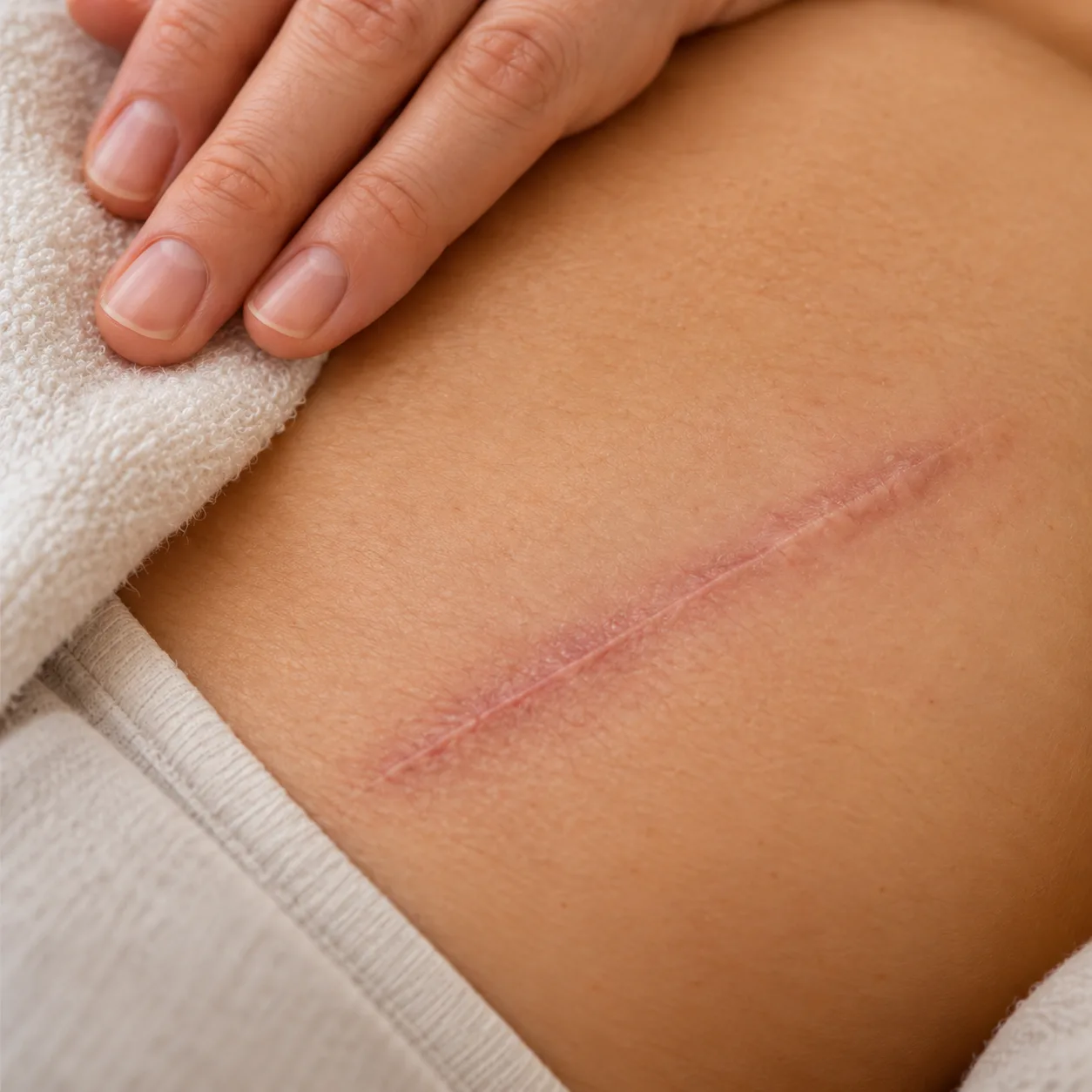
An operation changes tissue. The skin, underlying tissue, fasciae and — depending on the procedure — deeper structures all go through a healing process. Even after a wound has closed on the surface, the area can still feel or move differently for some time. This is why, once wound healing is complete, it can be worthwhile from an osteopathic perspective to look not only at the scar itself, but also at the mobility of the surrounding region.
What can change after an operation?
After a procedure, many people automatically protect the operated area at first. Movement becomes more cautious, muscles take on different roles, and the tissue is in the process of healing.
This is initially a normal process. However, if a persistent feeling of tension, restricted mobility, or a markedly altered movement pattern remains later on, a manual examination can be worthwhile.
Is every scar a problem?
No. A visible scar doesn't automatically mean it's causing complaints or needs osteopathic treatment. Many scars heal without any relevant functional restriction.
A scar becomes interesting to me when the surrounding area is noticeably tense or has limited mobility, and this finding fits the clinical picture.
When can work begin on a scar?
No osteopathic work is carried out on fresh wounds. Wound healing must be sufficiently advanced; if there is any uncertainty or a complicated healing process, the treating medical team should first assess what is already possible.
In the early phase, it can be more sensible to treat neighbouring regions first, without placing any direct strain on the surgical site.
What can scar treatment look like?
Once healing is complete, the skin and surrounding tissue can be examined and treated using gentle manual techniques. This concerns mobility, tension, and how the tissue interacts with the movement of that region of the body.
Scar treatment doesn't need to be forceful or painful. Sensitive tissue in particular benefits more from a well-dosed approach than from aggressive pressure.
Why do I sometimes look beyond the scar itself?
After an operation, it's often not just the tissue directly at the incision that changes. Protective posture and temporarily restricted movement can also affect neighbouring joints and muscle groups.
After abdominal surgery, for example, trunk movement and breathing can be of interest; after surgery on a joint, the movement of neighbouring sections can be too. Which regions are actually relevant becomes clear through the examination.
Osteopathy, physiotherapy and rehabilitation
Osteopathy doesn't replace postoperative rehabilitation or physiotherapy where these are medically indicated. Especially after major orthopaedic procedures, building up load tolerance, strength and active movement are central parts of recovery.
Osteopathic treatment can play a complementary role, focusing additionally on mobility and tissue tension.
My approach
I don't treat a scar simply because it's there. What matters is how it has healed, how the surrounding tissue moves, and whether there is a plausible connection with the current complaints.
This keeps treatment individual: sometimes the scar is the main focus, sometimes a neighbouring region — and sometimes there's nothing to treat at the scar at all.
Important information
Redness, increasing swelling or warmth, discharge from the wound, fever, newly occurring severe pain, or other signs of disturbed wound healing should first be checked medically.