%20rotate(45)'%3e%3cpath%20fill='%23B78437'%20d='%20M%200%200%20H%20113%20V%2061%20H%20140%20V%200%20H%20255%20V%20113%20H%20193%20V%20142%20H%20255%20V%20255%20H%20142%20V%20190%20H%20115%20V%20255%20H%200%20V%20141%20H%2063%20V%20113%20H%200%20Z'/%3e%3c!--%20Top%20/%20north%20ribbon%20--%3e%3cpath%20fill='%23FFFCF4'%20d='%20M%2023%2023%20H%2092%20V%20143%20H%2074%20V%2042%20H%2041%20V%2072%20H%2064%20V%2091%20H%2023%20Z'/%3e%3c!--%20Right%20/%20east%20ribbon%20--%3e%3cpath%20fill='%23FFFCF4'%20d='%20M%20164%2023%20H%20232%20V%2092%20H%20112%20V%2073%20H%20212%20V%2043%20H%20181%20V%2062%20H%20164%20Z'/%3e%3c!--%20Bottom%20/%20south%20ribbon%20--%3e%3cpath%20fill='%23FFFCF4'%20d='%20M%20162%20105%20H%20180%20V%20213%20H%20213%20V%20181%20H%20189%20V%20162%20H%20232%20V%20232%20H%20162%20Z'/%3e%3c!--%20Left%20/%20west%20ribbon%20--%3e%3cpath%20fill='%23FFFCF4'%20d='%20M%2025%20158%20H%20144%20V%20177%20H%2044%20V%20210%20H%2076%20V%20188%20H%2095%20V%20229%20H%2025%20Z'/%3e%3c!--%20Ether%20/%20unifying%20centre%20--%3e%3cpath%20fill='%23FFFCF4'%20d='M%20112%20109%20H%20145%20V%20143%20H%20112%20Z'/%3e%3c/g%3e%3c/svg%3e)
Osteopathy · 7 min
Headaches together with neck and jaw complaints
Headaches occurring together with neck or jaw complaints? Find out which functional connections are possible, how I examine, and when medical clarification is important.
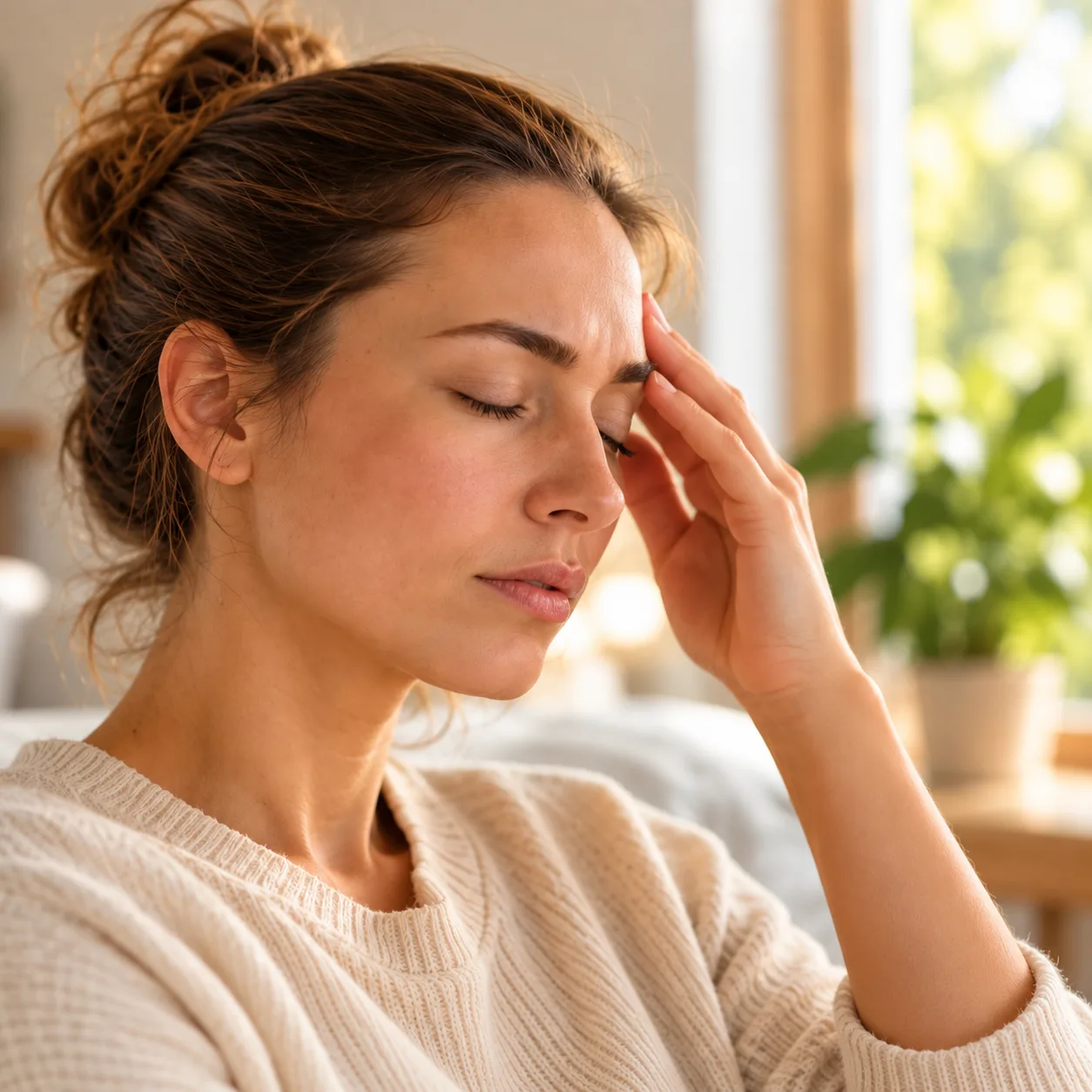
Headaches can have very different causes and forms. In some people, they occur together with neck tension, restricted mobility, or jaw complaints. In such cases, it can make sense to look at these areas together — without automatically attributing every headache to the cervical spine or the jaw.
Headache is not a single diagnosis
Tension headache, migraine and other headache types differ considerably. Frequency, duration, accompanying symptoms and triggers also provide important clues.
That's why the osteopathic examination here, too, begins with as precise a description as possible: Where is the pain located? What does it feel like? How long does it last? What occurs alongside it, and what changes it?
What role can the neck play?
The muscles and joints of the upper neck can be part of the clinical picture in certain types of headache. Clues might include head movements affecting the complaints, or a marked restriction in the neck occurring at the same time.
This doesn't mean, though, that every headache comes from a 'displaced vertebra' in the neck. Such simple explanations don't do justice to the variety of headaches that exist.
Jaw, clenching and teeth grinding
The jaw and chewing muscles can also be of interest — especially if there is clenching or grinding at the same time, jaw pain, or a change in mouth opening.
Where the complaints fit, I therefore examine not only the neck but also jaw movement, chewing muscles, and neighbouring structures.
Stress and tension
Stress can show up physically in different ways for different people. Some raise their shoulders, others clench their teeth, or notice persistently increased tension in the neck.
Such connections can become visible during conversation and are relevant to treatment when they fit the individual pattern. This isn't about hastily labelling headaches as 'psychological', but about considering possible physical and psychosocial contributing factors together.
How can osteopathic treatment help?
Depending on the findings, muscle and tissue techniques, mobilisations, and targeted techniques on the cervical or thoracic spine and jaw may be used.
Which region is treated follows from the examination. I don't automatically treat the upper cervical spine simply because headaches are present.
And with migraine?
Migraine is a neurological condition and cannot meaningfully be reduced to a single joint position, muscle tension, or jaw dysfunction.
If someone with migraine also has treatable complaints in the neck or jaw area, these can be considered separately from an osteopathic perspective. That's a different matter from claiming that a manipulation can 'correct' the cause of migraine.
My approach
With headaches, I'm first interested in the pattern, and only after that in the technique. If the neck or jaw are recognisably part of the clinical picture, they can be included in treatment.
This keeps osteopathic work where it belongs: with specific functional findings, rather than offering the same explanation for every type of headache.
Important information
A sudden, unusually severe headache, new neurological deficits, disturbances of consciousness, fever with pronounced accompanying symptoms, or a headache that is markedly different or unfamiliar in character all require prompt medical clarification.