%20rotate(45)'%3e%3cpath%20fill='%23B78437'%20d='%20M%200%200%20H%20113%20V%2061%20H%20140%20V%200%20H%20255%20V%20113%20H%20193%20V%20142%20H%20255%20V%20255%20H%20142%20V%20190%20H%20115%20V%20255%20H%200%20V%20141%20H%2063%20V%20113%20H%200%20Z'/%3e%3c!--%20Top%20/%20north%20ribbon%20--%3e%3cpath%20fill='%23FFFCF4'%20d='%20M%2023%2023%20H%2092%20V%20143%20H%2074%20V%2042%20H%2041%20V%2072%20H%2064%20V%2091%20H%2023%20Z'/%3e%3c!--%20Right%20/%20east%20ribbon%20--%3e%3cpath%20fill='%23FFFCF4'%20d='%20M%20164%2023%20H%20232%20V%2092%20H%20112%20V%2073%20H%20212%20V%2043%20H%20181%20V%2062%20H%20164%20Z'/%3e%3c!--%20Bottom%20/%20south%20ribbon%20--%3e%3cpath%20fill='%23FFFCF4'%20d='%20M%20162%20105%20H%20180%20V%20213%20H%20213%20V%20181%20H%20189%20V%20162%20H%20232%20V%20232%20H%20162%20Z'/%3e%3c!--%20Left%20/%20west%20ribbon%20--%3e%3cpath%20fill='%23FFFCF4'%20d='%20M%2025%20158%20H%20144%20V%20177%20H%2044%20V%20210%20H%2076%20V%20188%20H%2095%20V%20229%20H%2025%20Z'/%3e%3c!--%20Ether%20/%20unifying%20centre%20--%3e%3cpath%20fill='%23FFFCF4'%20d='M%20112%20109%20H%20145%20V%20143%20H%20112%20Z'/%3e%3c/g%3e%3c/svg%3e)
Digestive Health · 7 min
Digestive complaints and visceral osteopathy
Digestive complaints and visceral osteopathy: how the abdomen, diaphragm, back and pelvis are considered together functionally, and how treatment proceeds in my practice in Erfurt.
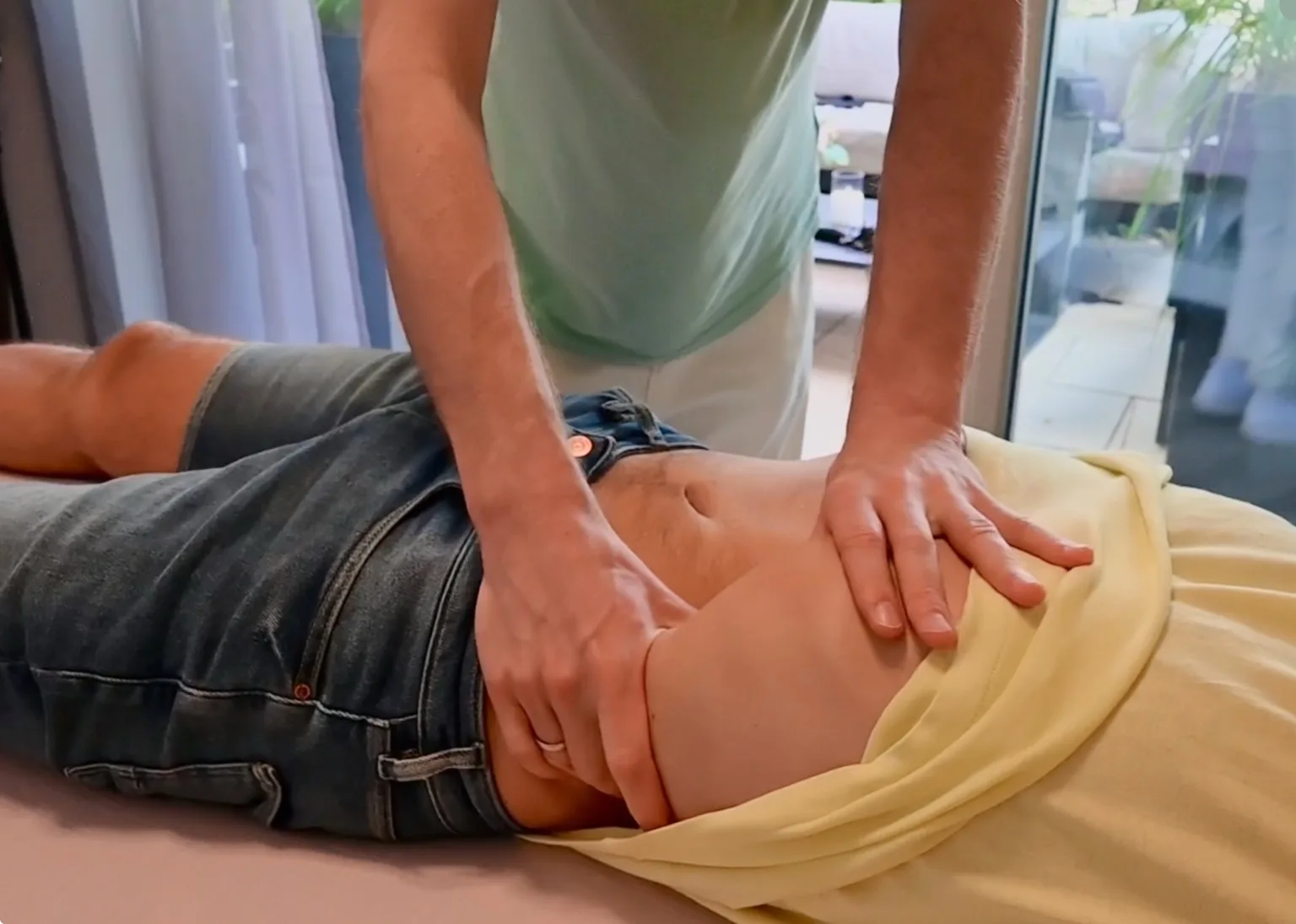
The abdomen is constantly in motion: through breathing, digestion, posture and the activity of the surrounding muscles. Abdominal complaints can have very different causes. In visceral osteopathy, the aim is therefore not to diagnose a digestive condition with the hands, but to functionally assess mobility and tension in the abdomen and neighbouring structures.
What does 'visceral' mean?
'Visceral' refers to the internal organs and their surroundings. In osteopathic work, this is mainly about the mobility and tension of tissue, as well as its relationship to the diaphragm, abdominal wall, back and pelvis.
These structures are anatomically connected and move, for example, with every breath. This is why it can make sense not to examine the abdomen entirely separately from the rest of the musculoskeletal system.
What concerns do patients bring?
Some patients report a recurring feeling of tension or pressure in the abdomen, others digestive complaints alongside back or pelvic problems. After operations, questions can also arise about how mobile scars and the surrounding tissue are.
Such complaints don't say anything about their cause on their own. In the abdominal area especially, it's important to take existing medical diagnoses and any necessary medical examinations into account.
How do I examine the abdomen osteopathically?
Alongside the conversation, depending on the question at hand, I examine breathing, the abdominal wall, the diaphragm, the back, the pelvis, and the mobility of tissue within the abdomen.
I'm not looking for a supposedly exact 'position' of an organ. What interests me more is where tissue is noticeably tense or less mobile, and whether this finding fits with the rest of the clinical picture.
What can treatment look like?
Visceral techniques are generally calm and precise. Work is done through the abdominal wall using appropriately adjusted pressure; the diaphragm, ribs, spine or pelvis can also be treated if relevant findings appear there.
Treatment should not involve pressing painfully 'into' the abdomen. Precision and appropriate dosage matter more than force.
Digestion is more than mechanics
Digestive complaints aren't determined solely by tissue mobility. Diet, bowel function, medication, illness, sleep and stress can all play a role too.
This is precisely why I find a holistic view valuable: manual findings can be part of the overall picture, but they don't automatically explain every digestive complaint.
Stress, breathing and abdominal tension
Many people are familiar with the abdomen's direct response to tension — a feeling of tightness, changed breathing, or a 'knot in the stomach'. Such reactions are real and can significantly change how the body feels.
If the conversation reveals a connection with strain or stress, this aspect can also be incorporated into treatment. Physical and medical causes, of course, remain separate questions in their own right.
My approach
With visceral osteopathy, I want neither to reduce every digestive problem to tissue tension, nor to treat the abdomen in isolation. I bring together the case history, existing medical information and the manual examination into an overall picture.
Treatment is given where a sensible functional approach presents itself — not wherever a theory insists that something must necessarily be 'released'.
Important information
New or severe abdominal pain, fever, persistent vomiting, blood in the stool, marked unintended weight loss, pronounced changes in digestion, or other acute or unclear complaints should be medically assessed.